


On This Page
What Is Turbo Excel Lookup?
Anyone who has managed spreadsheets for more than a few months has run into the same wall. You have two files, perhaps a list of orders and a list of customers, a payroll export and an HR roster, or a product catalog and a pricing sheet, and you need to bring information from one into the other. The traditional answer is the VLOOKUP Excel has shipped with for decades, or its modern successors XLOOKUP and INDEX-MATCH. Those functions work, but they carry real friction: brittle range references, #N/A errors triggered by a single stray space or a difference in capitalization, formulas that break silently when a column is inserted or deleted, and a practical ceiling on how many rows a live worksheet formula can handle before Excel begins to slow down.
Turbo Excel Lookup takes that same underlying problem, matching rows in one table against rows in another, and solves it with a dedicated engine built on the pandas data-analysis library rather than worksheet formulas. You load your two files, tell the application which columns should be treated as the matching key (or keys, for composite multi-column matching), choose a matching strategy from eleven available modes, and click Run. The result is a static, exportable table accompanied by statistics showing how many rows matched, how many did not, and how long the operation took. Because the result is not tied to live formula recalculation, the application processes far larger datasets comfortably. Because matching logic is chosen from a menu rather than typed as a formula, there is no syntax to get wrong.
Beyond the core lookup, the application bundles four additional tools that complete a full data-matching workflow: a SQL-style Join tab for combining whole rows between tables, a Duplicates tab for finding and handling repeated records, a Data Cleaning tab for normalizing messy text before you match it, and a Formula Generator for occasions when you specifically want a native, recalculating Excel formula rather than a static merged file. A Reports tab maintains a running session log of everything you have done, and every operation exports directly back to XLSX, CSV, or TSV.
Key Features
Visual Lookup & Merge Engine
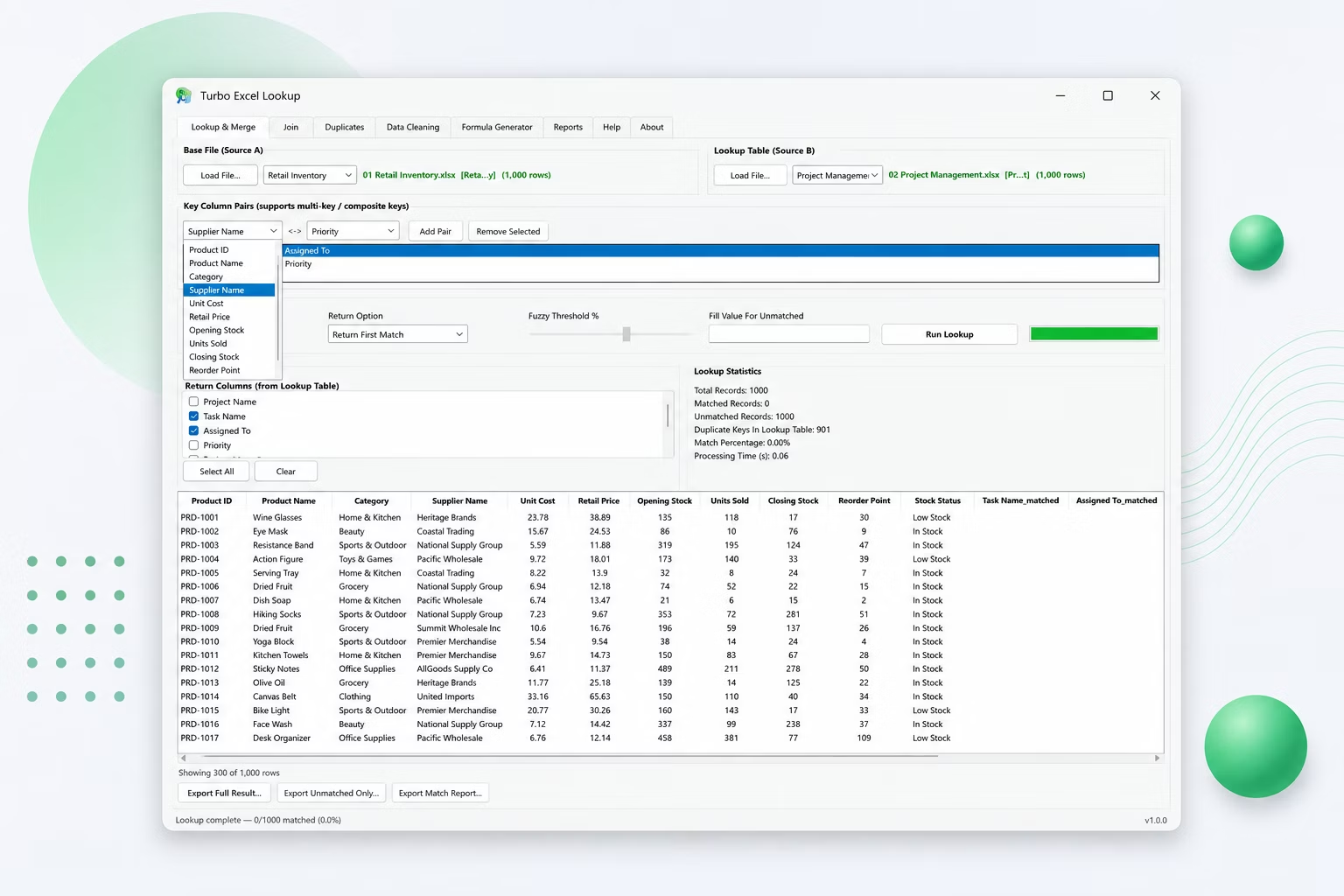
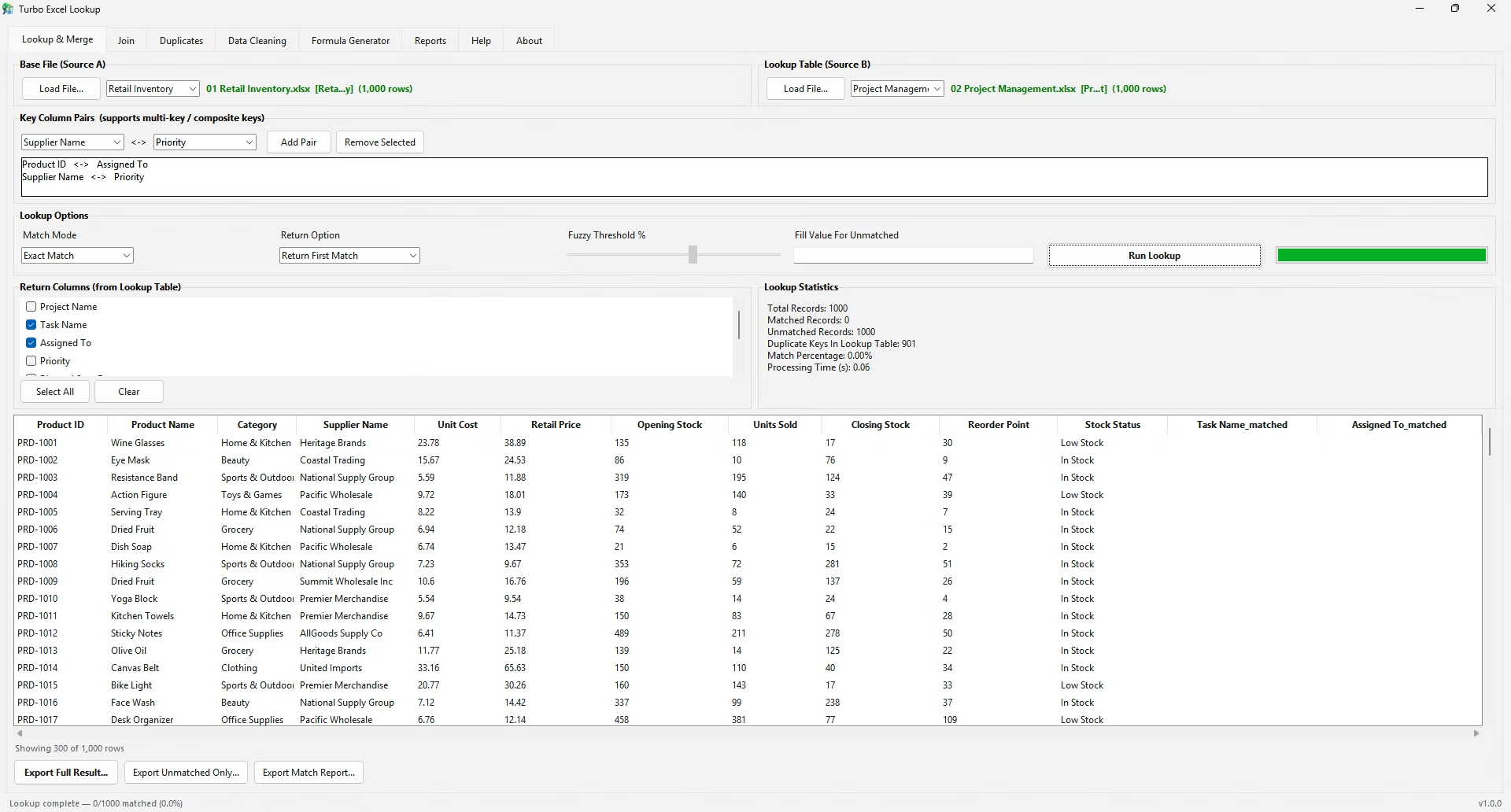
Load a base file and a lookup table, choose key column pairs, select the columns you want returned, and run the match. No formula writing is required, and the engine is built for far larger row counts than a live VLOOKUP formula can comfortably sustain.
Eleven Matching Modes
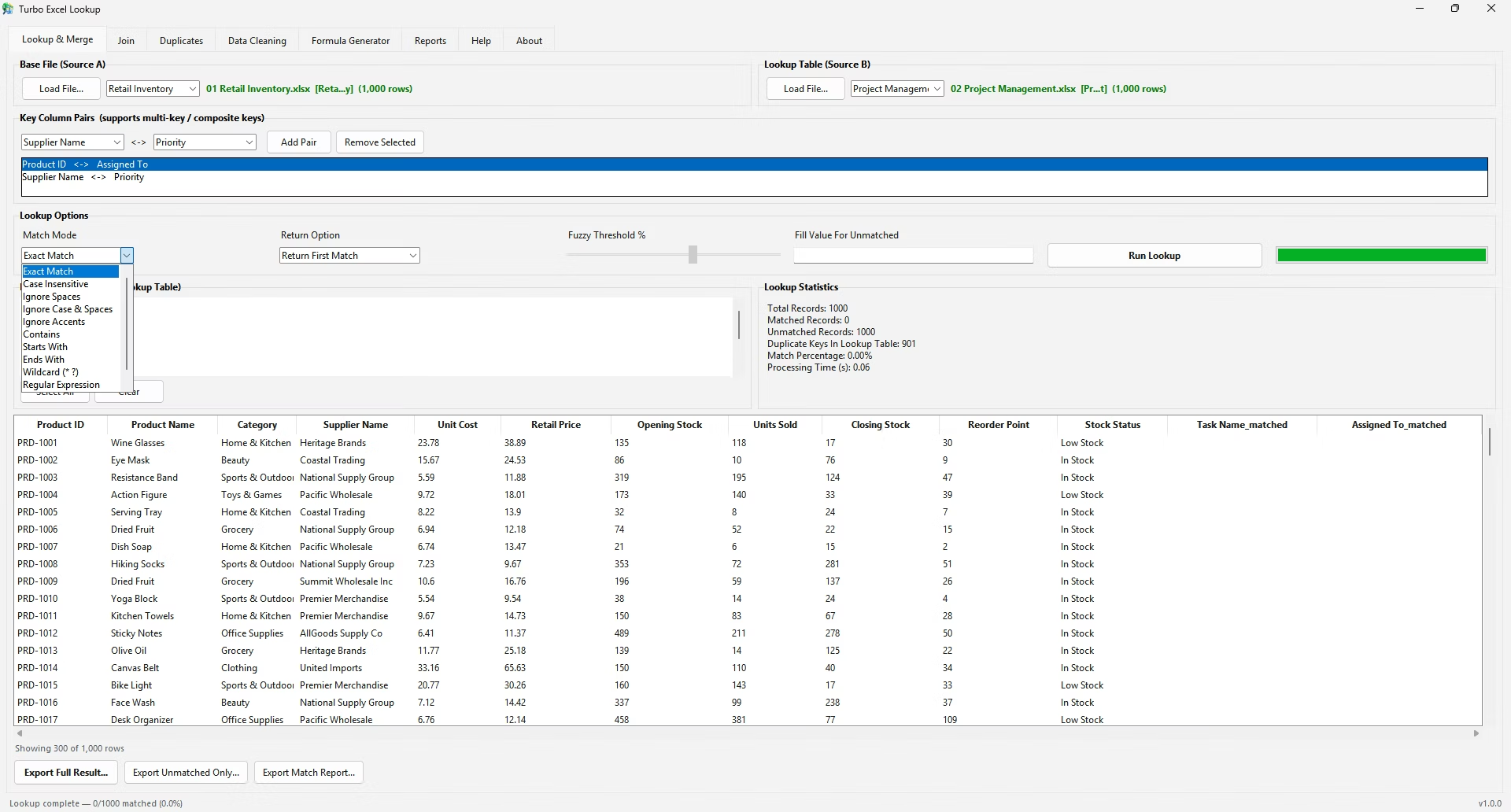
Everything from strict Exact Match through to forgiving fuzzy similarity matching with an adjustable threshold, plus Contains, Starts With, Ends With, Wildcard, and Regular Expression pattern matching for inconsistent source data.
Composite Multi-Key Lookups
Add more than one key column pair, such as First Name plus Last Name, or Order ID plus SKU, and the application builds a combined key automatically so you can match on several fields at once without creating helper columns.
Four Return Options
Return the first match, the last match, all matches concatenated into a single cell, or a match count. The count option is particularly useful for auditing how many times a value appears in your lookup table before you commit to a merge.
SQL-Style Join Tab
Left, Right, Inner, Full Outer, Anti, Semi, and Cross joins between two tables, for occasions when you need to combine complete rows rather than pull back a handful of lookup columns.
Duplicate Finder
Scan one or more key columns, then keep the first record, keep the last, isolate every duplicate group for review, or mark duplicates in place with Is_Duplicate and Duplicate_Group columns without deleting anything.
Data Cleaning Toolkit
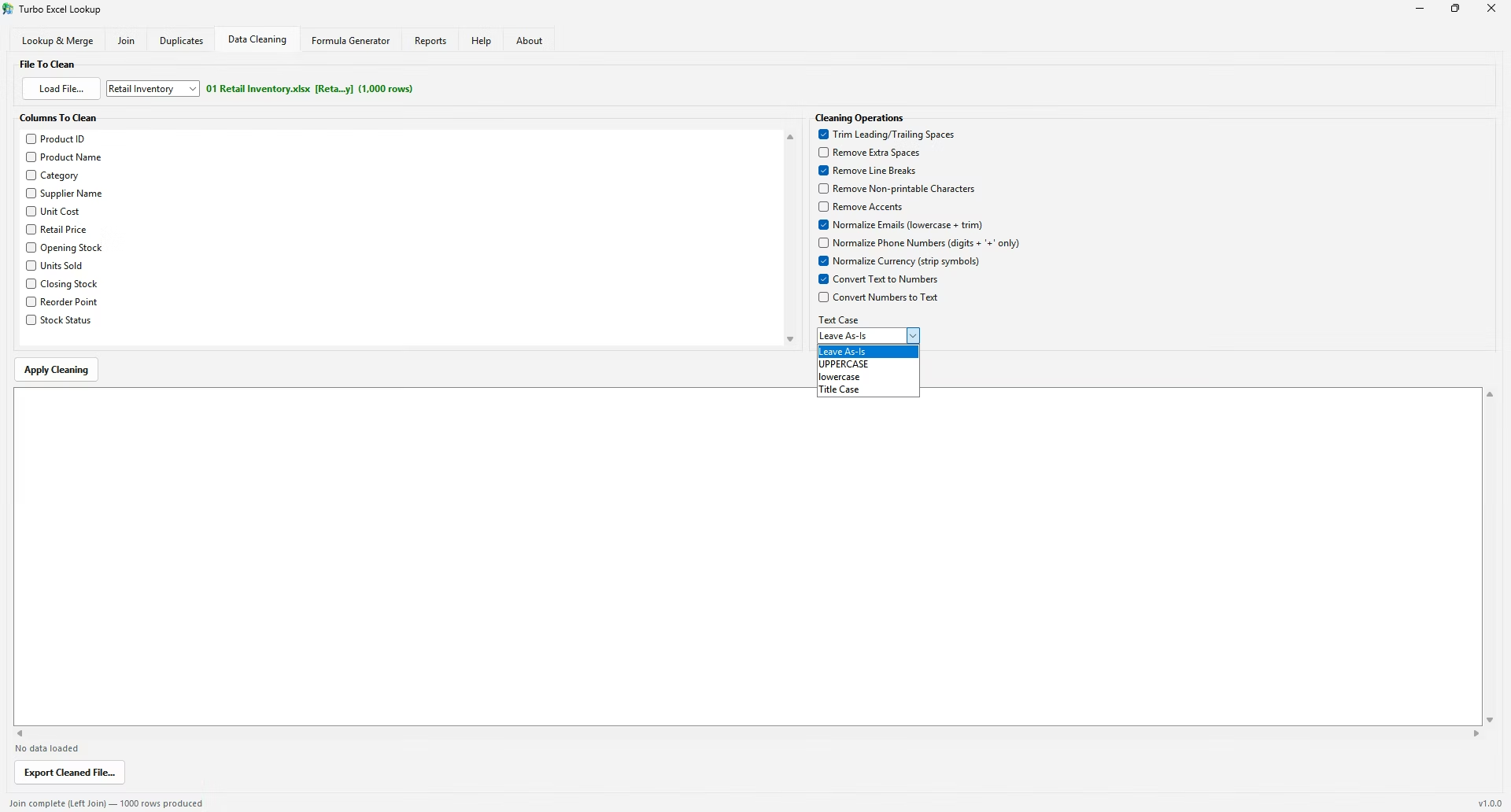
Trim spaces, collapse repeated whitespace, strip line breaks and non-printable characters, remove accents, normalize emails, phone numbers, and currency values, convert text to numbers and back, and apply case conversion, all before you match.
Native Formula Generator
Produces genuine VLOOKUP, XLOOKUP, INDEX/MATCH, INDEX/XMATCH, HLOOKUP, and IFERROR-wrapped VLOOKUP formula strings, and writes them directly into a workbook column so that Excel recalculates them live.
Match Statistics On Every Run
Each lookup reports total records, matched records, unmatched records, duplicate keys found in the lookup table, match percentage, and processing time. The summary exports as a standalone Match Report file.
Unmatched Row Export
Export only the rows that failed to find a match as a separate file, so you can investigate exceptions such as typos, missing records, and formatting mismatches without searching through the full result set.
Multi-Sheet Workbook Support
When you load an XLSX or XLSM file containing multiple sheets, a sheet picker appears automatically so you can select exactly which sheet feeds into the operation.
Session Reports Log
The Reports tab keeps a timestamped log of every lookup, join, duplicate scan, cleaning pass, and export performed during the session, exportable as a plain-text file for your records.
Who Turbo Excel Lookup Is For
Operations & Data Analysts
Anyone who spends a meaningful part of the week reconciling two exports, whether inventory against shipments, bookings against attendance, or CRM against billing, gains a repeatable, formula-free workflow with an accuracy report attached to every run.
Bookkeepers & Finance Teams
Matching bank statements, invoices, and payment records against internal ledgers benefits from composite-key matching and from an unmatched-only export that isolates precisely which transactions require human review.
Marketing & List Owners
Cleaning and deduplicating mailing lists, merging campaign exports with a CRM, and joining advertising-platform data against internal customer records all map directly onto the cleaning, matching, and join tools.
Excel Power Users Tired of #N/A
If you already know VLOOKUP and XLOOKUP well but are frustrated by how easily they break on messy, real-world text, Turbo Excel Lookup preserves the same mental model while removing the formula fragility.
HR & Payroll Administrators
Combining an HR system export with a payroll file, checking that every employee record has a matching pay record, and identifying starters and leavers between two monthly snapshots are all single-operation tasks here.
E-commerce & Catalog Managers
Reconciling supplier price lists against a live catalog, spotting SKUs that appear in one system but not the other, and merging product attributes from several vendor feeds are everyday uses of the lookup and join tabs.
It is worth being equally clear about what the application is not. It is not a full database engine, a business intelligence or reporting platform, or a substitute for Excel. It is a focused utility for one recurring, high-friction task, and it is built to handle that task well enough to replace the handful of formulas and helper columns most people currently construct by hand for the same purpose.
Lookup & Merge: How It Replaces VLOOKUP and XLOOKUP
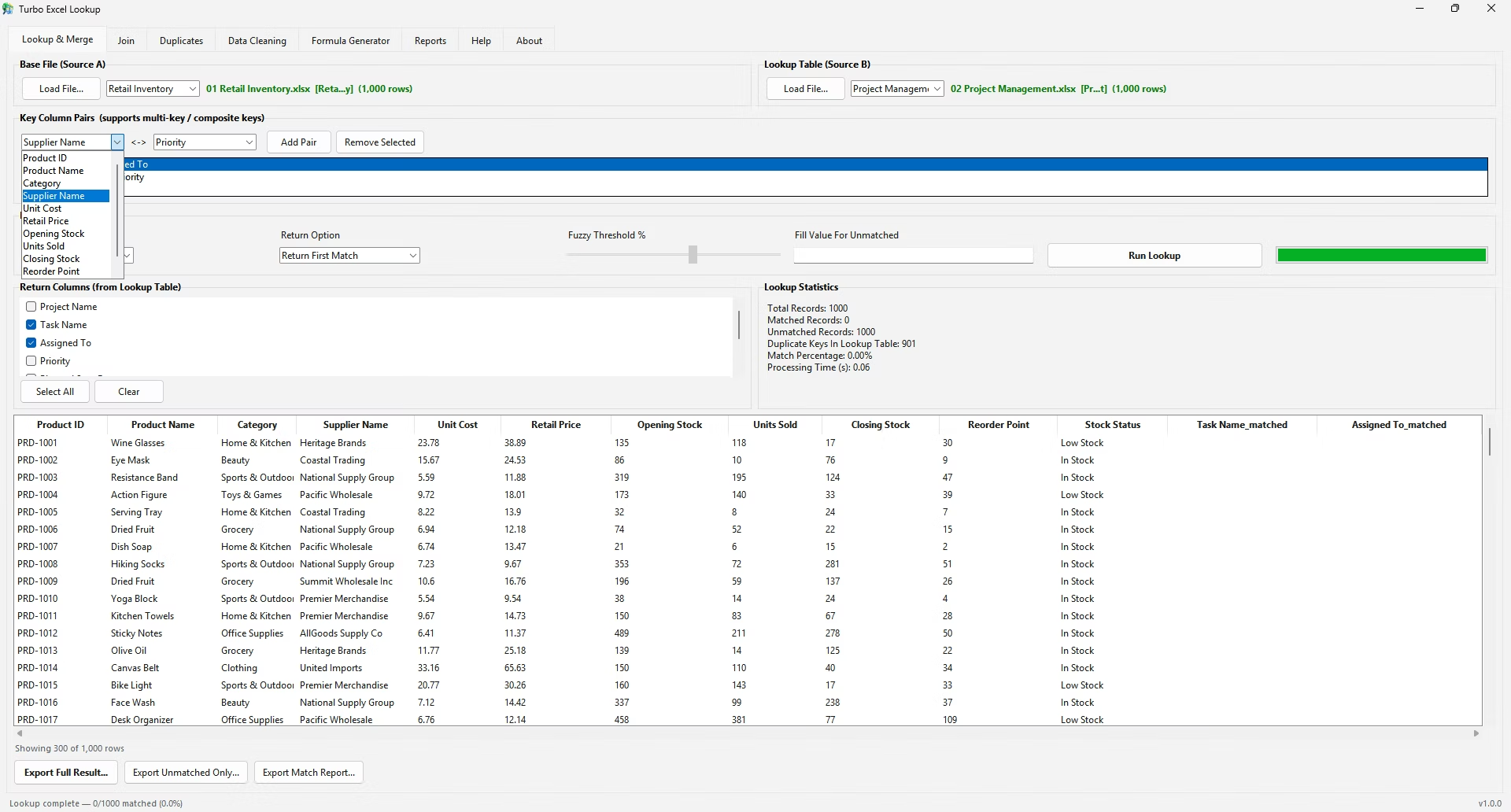
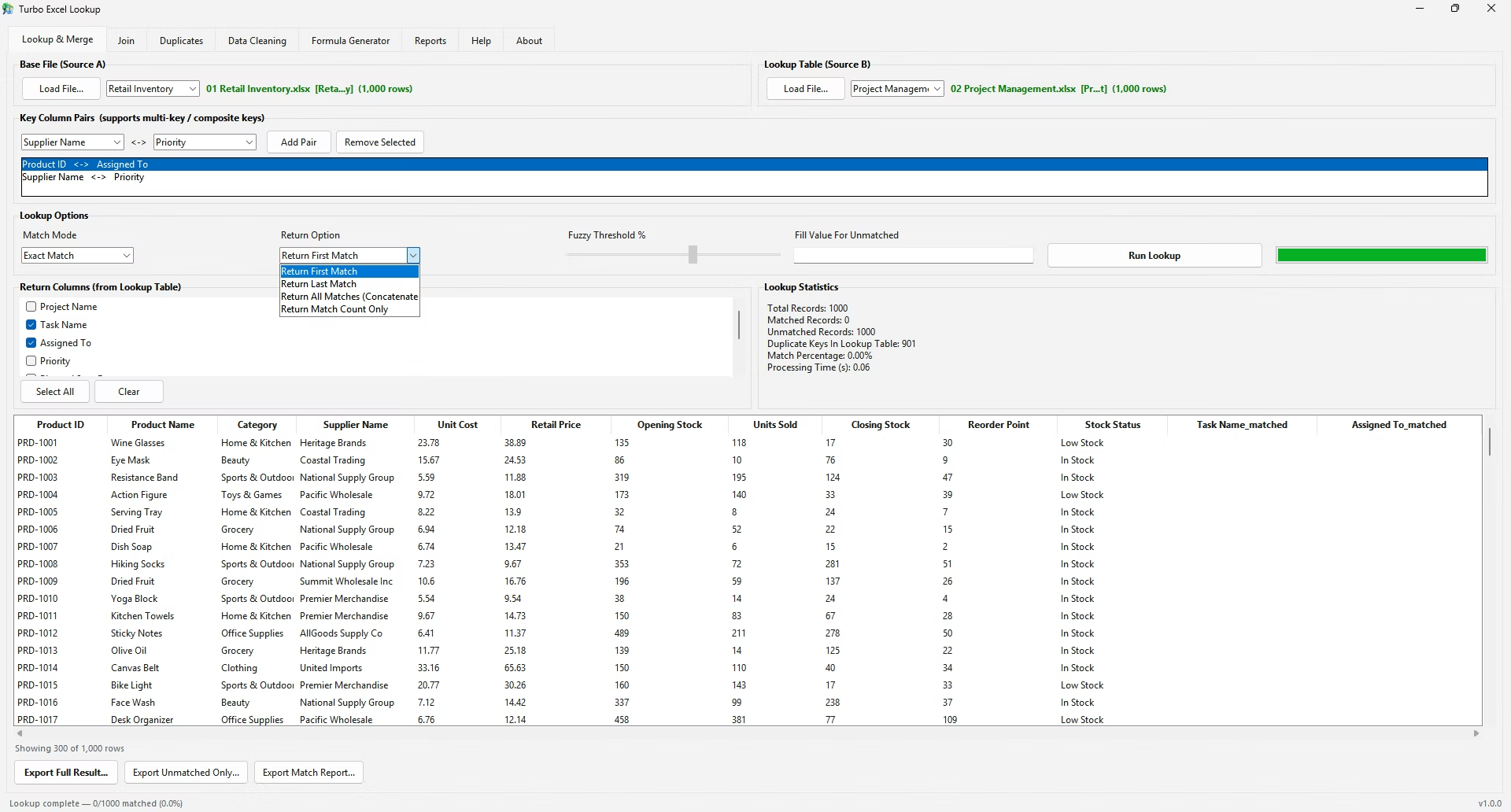
The Lookup & Merge tab is the heart of Turbo Excel Lookup, and it mirrors the mental model of VLOOKUP or XLOOKUP without the formula syntax. You load a Base File (Source A), which is the file you want to add data to, and a Lookup Table (Source B), which is the file you are pulling data from. Once both files are loaded, the application reads their column headers and lets you build one or more Key Column Pairs from a Source A column and a Source B column. Adding a second or third pair automatically converts the operation into a composite, multi-key lookup, something that requires nesting several formulas together in native Excel.
The Lookup Workflow, Step by Step
- Load the base file and the lookup table, in any combination of XLSX, XLSM, XLSB, CSV, or TSV.
- Add one or more key column pairs to define what a match actually means for your data.
- Choose a match mode: Exact, one of the normalized modes, or a pattern-based mode.
- Choose a return option: first match, last match, all matches, or match count.
- Tick the columns from the lookup table that you want pulled into the result.
- Optionally set a fill value to apply to rows that find no match, instead of leaving them blank.
- Click Run Lookup. A progress bar tracks the operation and statistics appear on completion.
- Export the full result, the unmatched rows alone, or a standalone match report.
Why It Handles Larger Datasets Than a Worksheet Formula
For the fast matching modes, which are Exact, Case Insensitive, Ignore Spaces, Ignore Case & Spaces, and Ignore Accents, Turbo Excel Lookup builds a normalized key for both files and performs the match using the vectorized merge operations in pandas, the same underlying approach used by high-performance data pipelines. This is dramatically faster than a worksheet formula recalculating row by row, particularly once a spreadsheet grows into the tens or hundreds of thousands of rows. For the pattern-based modes, which are Contains, Starts With, Ends With, Wildcard, Regular Expression, and Fuzzy, the application switches to a multi-threaded, row-by-row comparison configurable up to eight parallel workers, because those modes inherently require checking each left-side value against the relevant right-side values individually.
How to Use VLOOKUP in Excel
If you have ever typed =VLOOKUP( into a cell and hoped for the best, you already know the basic pattern: give the function a value to search for, the range to search in, the column number to pull back, and whether the match needs to be exact. VLOOKUP remains the most common way people combine two spreadsheets, and it is worth understanding properly even if you eventually reach for a dedicated tool for anything larger than a one-off task. This section is a concise reference to the formula itself, followed by an honest assessment of where it stops being the right instrument for the job. If your real question is how do I use VLOOKUP without it quietly breaking three weeks later, the subsections below answer that directly.
VLOOKUP Syntax at a Glance
| Argument | Meaning | Common Mistake |
|---|---|---|
lookup_value | The value you are searching for, usually a cell reference such as A2 | Pointing at a cell that contains trailing spaces or a number stored as text |
table_array | The range containing both the search column and the column you want returned | Using a relative reference that shifts as you copy the formula down |
col_index_num | The column number to return, counted from the left edge of the range | Counting from the worksheet's column A instead of from the range's first column |
range_lookup | FALSE or 0 for an exact match, TRUE or 1 for an approximate match | Leaving the argument out entirely, which defaults to an approximate match |
Two of those four arguments cause most of the trouble in practice. The range that Excel in VLOOKUP terminology calls the table array must always begin with the column holding the search value, which is precisely why the function can never look leftward. And col_index_num is a position rather than a name, so the moment somebody inserts a column inside that range, every formula pointing at it quietly returns the wrong field. Neither problem announces itself; both simply produce plausible, wrong answers.
The Six Classic Steps
- Click the cell where you want the result to appear.
- Type
=VLOOKUP(and select the cell containing the value you are searching for. - Select the full range that contains both the search column and the column you want returned, then press F4 to make the reference absolute.
- Enter the column number, counted from the left edge of that range, that you want returned.
- Add
FALSEas the final argument for an exact match, orTRUEfor an approximate match on sorted data. - Press Enter, then copy the formula down the column to apply it to every row.
Using VLOOKUP Across Two Separate Files
Writing the formula is usually the easy part. The harder question is what happens when the two datasets live in separate workbooks rather than two tabs of the same file. You have two options: open both files and reference the second workbook by name inside the formula, which produces a lengthy external reference including the full file path, or copy one sheet into the other workbook first and reference it locally. The first approach creates a link that breaks the moment either file is moved, renamed, or opened on another machine. The second creates a snapshot that silently goes stale as soon as the source is updated. Neither is wrong, but both require discipline that is difficult to maintain across a team. This is the point at which the long partnership between Excel and VLOOKUP starts to strain: the formula is correct, and it is the link between the two files that fails.
Keeping a VLOOKUP From Breaking
Learning how to use VLOOKUP in Excel safely is far more about these habits than about the syntax. The honest answer is: with care, absolute range references, and a habit of checking your results rather than trusting them. Use absolute references for the table array, avoid inserting or deleting columns inside the lookup range, keep the returned column index in sync when the table changes shape, and consider converting your ranges into named Excel tables so that references adjust automatically. Turbo Excel Lookup sidesteps the question rather than answering it. Instead of writing lookup syntax by hand, you load a base file and a lookup table, choose the matching columns visually, and run the match. There is no range to break, no column index to fall out of sync, and no external link to lose.
VLOOKUP Excel Quick Answers
The questions below are the ones people type into a search box almost word for word: how do I use VLOOKUP across two files, how do you use a VLOOKUP in Excel when the spelling differs slightly between systems, and why does a v lookup formula keep returning #N/A on data that looks perfectly fine. Each answer is deliberately short, and each one ends with the equivalent step inside Turbo Excel Lookup, so you can see where the VLOOKUP Excel gives you runs out and where a dedicated matching tool takes over.
How Do I Use VLOOKUP Between Two Separate Workbooks?
Open both files, start the formula in the destination workbook, and select the range in the second workbook so that Excel writes the external reference for you. What you get back is a long, path-based reference that works only for as long as both files stay exactly where they are. For anyone who has to hand the file to a colleague, this is the weakest link in the whole workflow. In the application you load the two files side by side as Source A and Source B, run the match, and export a new file; nothing links the two afterwards, because the answer is already written into the result.
How Do You Use a VLOOKUP in Excel With More Than One Key Column?
Natively, you build a helper column in both tables that concatenates the keys, for example =A2&"|"&B2, and run the lookup against that helper instead. It works, but it leaves two extra columns to maintain and a helper that has to be rebuilt every time the data refreshes. Turbo Excel Lookup removes the helper column entirely: add a second or third Key Column Pair and the match becomes composite automatically. It is one of the clearest cases where knowing how to use VLOOKUP in Excel is a different thing from VLOOKUP being the right tool.
Can I Run a VLOOKUP on an XLS File?
Excel itself has no problem with a VLOOKUP XLS workbook, since the legacy 97-2003 format still opens in current versions. Turbo Excel Lookup does not read that format directly, so a VLOOKUP XLS file needs one conversion step first: open it in Excel, choose Save As, and pick .xlsx. The conversion takes a few seconds, preserves your data, and has the useful side effect of lifting the 65,536-row ceiling the old format imposes.
Why Does a V Lookup Formula Return #N/A on Data That Looks Correct?
Almost always because a value that reads as identical to a human is not identical to a spreadsheet: a trailing space, a number stored as text, a stray capital letter, or an accented character. A v lookup formula has no tolerance setting, so there is nothing to loosen and no diagnostic to consult. The normalized match modes in this application, and the Data Cleaning tab sitting alongside them, exist specifically to remove that entire category of failure before the match ever runs.
Is the Formula Still Worth Learning?
Yes. Knowing how do I use VLOOKUP for a quick answer on a small table remains a genuinely useful skill, and there is no sense in opening a separate application to look up twelve values. The pairing of Excel and VLOOKUP only becomes a liability at scale: tens of thousands of rows, keys that need normalizing first, matches that somebody will later ask you to justify. That is the point at which the Formula Generator on this page is more useful than the formula itself, because it writes correct syntax for you and still leaves a live, recalculating formula behind for whoever inherits the workbook.
VLOOKUP vs XLOOKUP vs INDEX-MATCH
Excel offers three established ways to look a value up in another table, and choosing between them causes a surprising amount of confusion. The table below summarizes the practical differences, followed by guidance on which to reach for and where all three share the same underlying weaknesses.
| Consideration | VLOOKUP | XLOOKUP | INDEX-MATCH |
|---|---|---|---|
| Availability | Every version of Excel | Microsoft 365 and Excel 2021 onward | Every version of Excel |
| Can look to the left of the key | No | Yes | Yes |
| Breaks when a column is inserted | Yes, the column index shifts | No, ranges are referenced directly | No, ranges are referenced directly |
| Default match behavior | Approximate unless you specify FALSE | Exact by default | Requires an explicit 0 for exact |
| Built-in fallback for no match | No, requires IFERROR | Yes, an if_not_found argument | No, requires IFERROR |
| Readability for colleagues | High, widely recognized | High, but unfamiliar to older users | Lower, two nested functions |
| Wildcard support | Limited, exact-match mode only | Yes, via match mode 2 | Yes, via MATCH |
| Fuzzy or approximate text matching | Not supported | Not supported | Not supported |
Which One Should You Use?
If your organization runs Microsoft 365 or Excel 2021 and later, XLOOKUP is generally the best of the three. It defaults to exact matching, which removes an entire class of silent error, it can return values from columns to the left of the key, something Excel in VLOOKUP form cannot do at all, and its built-in if_not_found argument makes IFERROR wrappers unnecessary. If you need a workbook to open correctly in older versions of Excel, INDEX-MATCH is the most robust choice, because it survives column insertions and works in both directions, at the cost of being harder for colleagues to read. VLOOKUP remains perfectly serviceable for simple, stable tables and has the advantage that almost everyone recognizes it immediately.
The Weakness All Three Share
Notice the final row of the table. None of the three functions can match text that is nearly but not exactly the same. "Acme Corp" and "Acme Corporation" are different values to all of them, as are "O'Brien" and "OBrien", "jose@example.com " with a trailing space and "Jose@Example.com" without. In real datasets assembled from different systems, this is not an edge case but the normal condition. The usual workaround is a chain of nested TRIM, UPPER, SUBSTITUTE, and CLEAN functions inside the lookup, which works but produces formulas that nobody, including their author, can comfortably read six months later. It is the one gap that no amount of fluency with Excel and VLOOKUP can close.
Why Lookups Fail: A Practical Guide to #N/A
A lookup that returns #N/A is rarely telling you that the data is missing. Far more often it is telling you that two values a human would read as identical are not identical to a computer. The table below lists the causes that account for the overwhelming majority of failed lookups, how to confirm each one, and how Turbo Excel Lookup addresses it.
| Cause | How to Confirm It | How the App Handles It |
|---|---|---|
| Leading or trailing spaces | Compare LEN(A2) against LEN(TRIM(A2)), or check whether the value is left-aligned when it should be right-aligned | Ignore Spaces or Ignore Case & Spaces match modes, or a Trim pass in the Data Cleaning tab |
| Inconsistent capitalization | Test with =EXACT(A2,B2), which is case-sensitive where a plain equals comparison is not | Case Insensitive matching, or a case-conversion pass before matching |
| Numbers stored as text | Look for a green triangle in the cell corner, or test with =ISTEXT(A2) | Text-to-number conversion in the Data Cleaning tab |
| Non-printable characters | Compare LEN() against the visible character count, especially on data pasted from web pages or PDFs | Remove non-printable characters and strip line breaks in the Data Cleaning tab |
| Accented characters | Search for the plain-ASCII spelling and check whether it returns fewer rows than expected | Ignore Accents match mode, or an accent-removal cleaning pass |
| Approximate match left enabled | Check whether the final argument, the one Excel in VLOOKUP calls range_lookup, is TRUE or omitted on unsorted data | Match behavior is an explicit choice rather than a defaulted argument |
| Genuine spelling differences | Sort both lists and compare the unmatched values by eye | Fuzzy matching with an adjustable similarity threshold |
A Diagnostic Routine That Works
When a match rate comes back lower than expected, resist the temptation to loosen the match mode immediately. Loosening the criteria hides the problem rather than solving it, and a fuzzy match applied to a whitespace issue will produce approximately correct results where an exact match on cleaned data would have produced entirely correct ones. Instead, export the unmatched rows on their own and look at ten of them. In almost every case the pattern becomes obvious within seconds: every failing value has a trailing space, or every failing value is a number formatted as text, or every failing value comes from one particular source system that formats names differently. Fix that specific cause in the Data Cleaning tab, then run the match again on the fast path.
Matching Modes Explained
Real-world data is rarely perfectly consistent between two files. One export might contain "Bob Smith" while the other contains "bob smith " with a trailing space, or "José García" in one system and "Jose Garcia" in another that strips accents on export. The eleven match modes in Turbo Excel Lookup exist specifically to absorb that inconsistency without requiring you to clean every cell first.
| Match Mode | Example | Best For |
|---|---|---|
| Exact Match | "Bob" matches "Bob" only | Clean, consistently formatted keys such as IDs or SKUs |
| Case Insensitive | "Bob" = "bob" = "BOB" | Data entered with inconsistent capitalization |
| Ignore Spaces | "B ob" = "Bob" | Copy-pasted values carrying stray internal spaces |
| Ignore Case & Spaces | " b OB " = "Bob" | Combining both fixes above in a single mode |
| Ignore Accents | "José" = "Jose" | International names and addresses exported without diacritics |
| Contains | The right-hand value appears anywhere inside the left-hand value | Matching partial product codes or embedded reference numbers |
| Starts With | The left-hand value begins with the right-hand value | Prefix matching, such as account or invoice number ranges |
| Ends With | The left-hand value ends with the right-hand value | Suffix matching, such as file extensions or region codes |
| Wildcard | * matches any characters, ? matches one character | Familiar shell-style pattern matching without writing a regular expression |
| Regular Expression | The right-hand value is a regex pattern searched within the left-hand value | Complex, rule-based matching for advanced users |
| Fuzzy / Similarity % | "Microsft" resembles "Microsoft" above your chosen threshold | Typos, abbreviations, and near-duplicate free-text entries |
The five normalized modes, from Exact through Ignore Accents, run through the fast vectorized merge path. The six pattern-based modes, including fuzzy matching, run through the multi-threaded row-by-row path, with fuzzy mode exposing an adjustable similarity threshold slider from 50 to 100 percent so you can control how loose or strict the approximate matching should be.
Fuzzy Matching in Depth
Fuzzy matching is the mode people are most curious about and the one that most rewards a little understanding before use. Rather than asking whether two values are equal, it asks how similar they are, producing a score from 0 to 100 for each candidate pair. You set a threshold with a slider, ranging from 50 to 100 percent and defaulting to 80, and only pairs scoring at or above that threshold are treated as matches. Where several candidates clear the threshold, the highest-scoring one is returned.
What the Threshold Actually Controls
The threshold is a trade-off between two kinds of error, and moving it in either direction reduces one while increasing the other. A high threshold, in the region of 90 to 95 percent, catches only genuine typographical variants: a transposed pair of letters, a missing character, a doubled character. A moderate threshold around 80 percent additionally catches abbreviations and word-order differences. A low threshold near 60 percent will match values that share little more than a common prefix, and at that level you should expect to review every match by hand. The default of 80 is a reasonable starting point for company names and free-text entries, but it is a starting point rather than a recommendation for all data.
| Threshold | Typically Matches | Suitable For |
|---|---|---|
| 95 to 100 percent | Single-character typos and case or spacing differences only | Near-clean data where you want a small safety margin |
| 85 to 94 percent | Typos, missing punctuation, minor suffix differences | Customer and supplier names from two well-maintained systems |
| 75 to 84 percent | Abbreviations, dropped words such as Ltd or Inc, reordered terms | Company names collected from mixed sources |
| 60 to 74 percent | Loose resemblance, frequently including incorrect pairs | Exploratory review only, with manual verification of every result |
| Below 60 percent | Values sharing only partial structure | Rarely useful; consider a different key instead |
Wildcard and Regular Expression Reference
Wildcard and regular expression modes are for structural matching, where you know the shape of the value you are looking for rather than its exact content. Wildcards are the simpler of the two and use the same conventions as Windows file search, so most people already know them. Regular expressions are considerably more powerful and correspondingly easier to get wrong.
Wildcard Patterns
| Pattern | Meaning | Matches |
|---|---|---|
INV-* | Any value beginning with INV- | INV-1001, INV-2024-B |
*-2024 | Any value ending with -2024 | ORD-2024, REF-99-2024 |
SKU-???? | SKU- followed by exactly four characters | SKU-A1B2, but not SKU-A1B |
*Ltd* | Any value containing Ltd anywhere | Acme Ltd, Ltd Holdings Group |
Common Regular Expression Patterns
| Pattern | Purpose |
|---|---|
^[A-Z]{3}-\d{4}$ | Three uppercase letters, a hyphen, then exactly four digits |
\d{5}(-\d{4})? | A five-digit postal code with an optional four-digit extension |
^\+?\d{10,14}$ | An international phone number with an optional leading plus sign |
[A-Za-z0-9._%+-]+@[A-Za-z0-9.-]+ | An email address embedded within a longer text field |
(?i)acme | The word acme in any combination of upper and lower case |
A word of caution that applies to both modes. Pattern matching answers the question "does this value have the right shape", not "is this the same record". A pattern that matches invoice numbers beginning with INV- will match every such invoice, so if several exist for one key, your return option determines which one you receive. Where a pattern could plausibly match more than one row, use the Match Count return option first to see how many candidates each key attracts before committing to a merge. If the counts are frequently above one, the pattern is doing identification work that it is not precise enough to do, and a composite key will serve you better.
Return Options: Controlling What Comes Back
A lookup does not only need to find the right rows; it needs to decide what to do when a key matches more than one of them. Native lookup formulas make that decision for you by silently returning the first match. Turbo Excel Lookup makes it an explicit choice with four options.
Return First Match
The standard VLOOKUP-style behavior. For each row in the base file, the columns from the first matching row found in the lookup table are returned.
Return Last Match
Useful when your lookup table is ordered chronologically and you want the most recent matching record rather than the earliest one encountered.
Return All Matches, Concatenated
Rather than returning a single match, every matching value for a given key is combined into one semicolon-separated cell, which is useful when a key legitimately corresponds to several valid records.
Return Match Count Only
Skips pulling any columns and instead reports how many times each key appears in the lookup table, a fast way to audit for unexpected duplicates before running a full merge.
Whichever option you choose, you can also set a fill value that is applied to every unmatched row instead of leaving those cells blank. Filling unmatched customer IDs with "NOT FOUND", for example, makes them easy to spot and filter for later, and distinguishes a failed match from a genuinely empty field in the source data, which a blank cell cannot do.
Join Operations: Combining Whole Tables
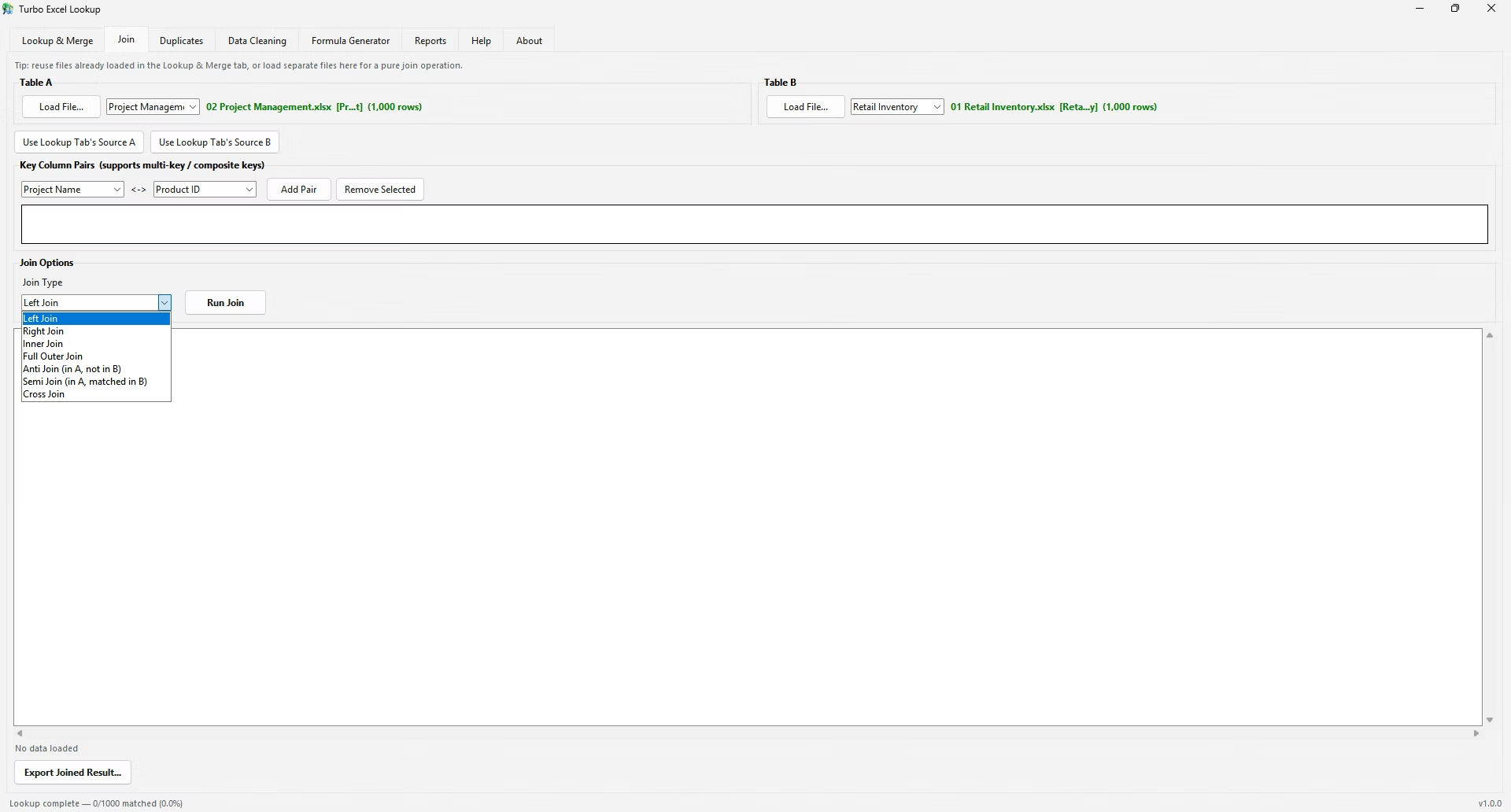
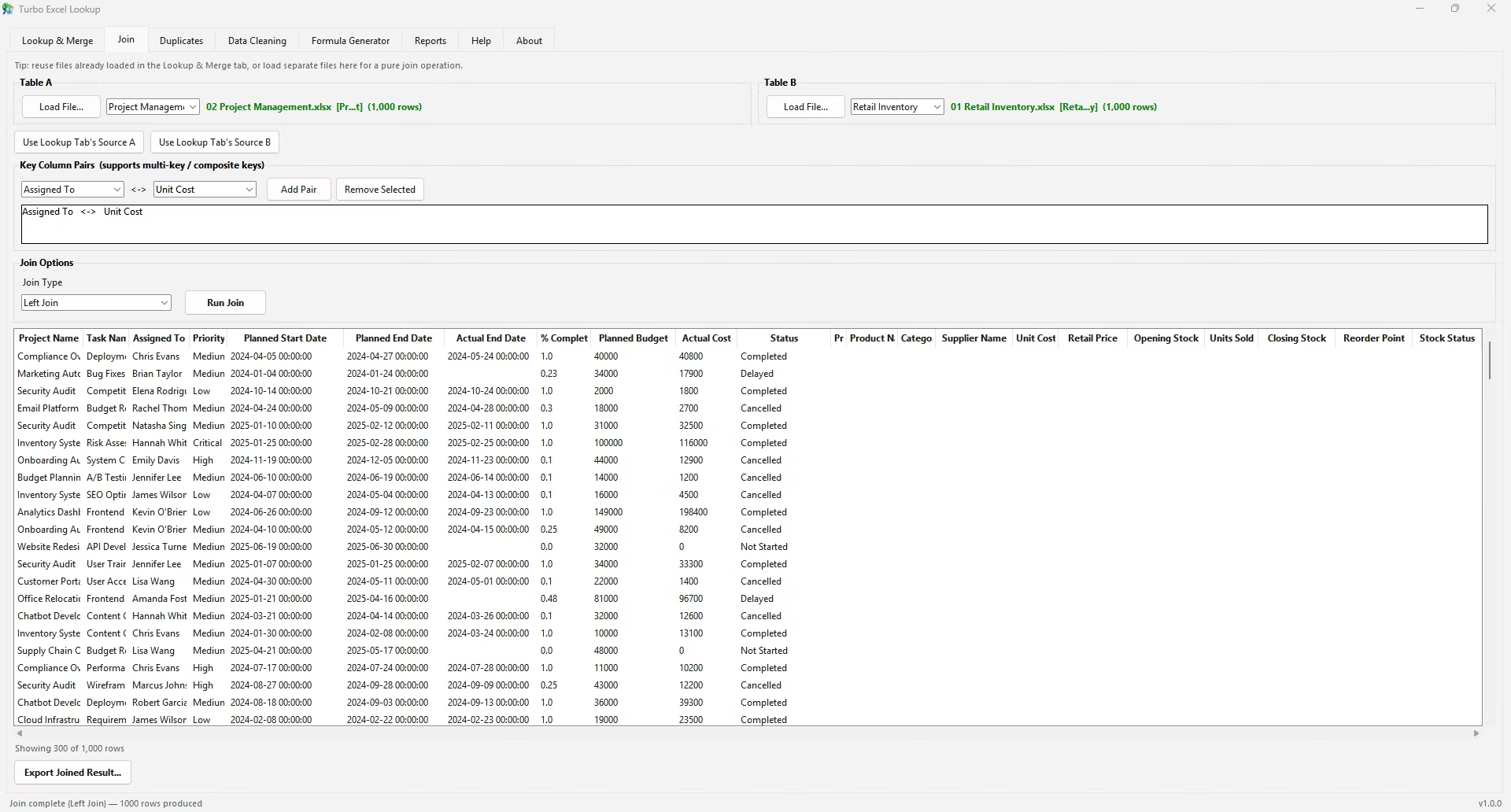
Where the Lookup & Merge tab is about pulling specific columns from a lookup table into a base file, the Join tab is for combining two complete tables the way a database would, keeping every column from both sides according to how their key columns relate. You can load fresh files directly into the Join tab, or click "Use Lookup Tab's Source A/B" to reuse whatever is already loaded on the Lookup & Merge tab, which avoids loading the same files twice.
| Join Type | What It Returns | When to Reach for It |
|---|---|---|
| Left Join | Every row from Table A, with matching columns from Table B where available | Enriching a primary list without losing any of its rows |
| Right Join | Every row from Table B, with matching columns from Table A where available | The same operation viewed from the other table |
| Inner Join | Only rows where the key exists in both tables | Producing a confirmed overlap between two lists |
| Full Outer Join | Every row from both tables, matched where possible and blank where not | Reconciling two sources without discarding anything from either |
| Anti Join | Rows in Table A with no match in Table B | Finding missing, new, or orphaned records |
| Semi Join | Rows in Table A that do have a match in Table B, without adding Table B's columns | Filtering a list down to confirmed entries without widening it |
| Cross Join | Every row in Table A paired with every row in Table B, a full Cartesian product | Generating all combinations, such as a price grid across regions |
Anti and Semi joins in particular solve a problem that is genuinely awkward in native Excel. Finding exactly which records exist in one file but not the other typically requires a combination of COUNTIF, IF, and filtering, repeated in reverse to check the opposite direction. Here it is a single dropdown selection, and running the same Anti join in both directions gives you a complete picture of the differences between two lists in two operations.
Duplicate Detection and Cleanup
The Duplicates tab scans a file for repeated records based on whichever key column or columns you select, then lets you decide exactly how to handle what it finds:
- Keep First, Drop Rest. Deduplicates the file, retaining only the first occurrence of each key.
- Keep Last, Drop Rest. Deduplicates the file, retaining only the last occurrence of each key, which is typically what you want when rows are appended chronologically and the most recent version is authoritative.
- Show Only Duplicate Records. Returns every copy of every duplicate group so you can review them side by side before deciding anything.
- Mark Duplicates. Leaves every row in the file untouched but adds an Is_Duplicate flag and a Duplicate_Group identifier, so you can review and decide manually before removing anything.
Every duplicate scan reports total rows, duplicate groups found, total duplicate rows across all copies, and the resulting count of unique rows, giving you a clear before-and-after picture of your dataset's integrity.
Choosing the Right Duplicate Key
The definition of a duplicate is a business decision rather than a technical one, and the key columns you select are how you express it. Two customer records sharing an email address are almost certainly the same person. Two order lines sharing a product code are almost certainly not the same order. Two employee records sharing a surname are certainly not the same employee. Before scanning, decide what "the same record" means for the dataset in front of you, then select the columns that encode that meaning.
Data Cleaning: Preparing Messy Data Before You Match
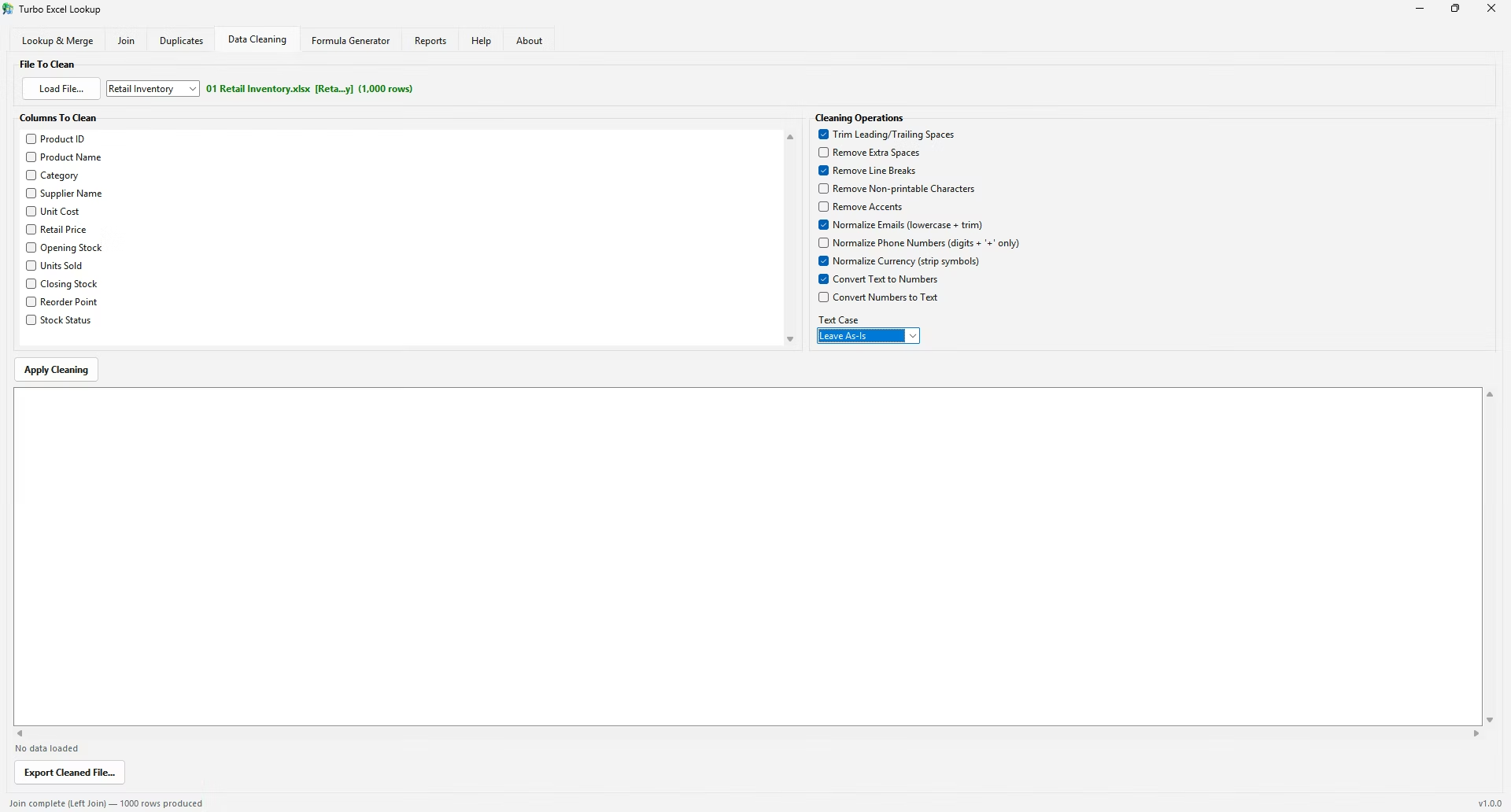
Most failed lookups are not caused by data that is genuinely different. They are caused by data that looks the same to a human but is not identical to a computer: a trailing space, a stray line break pasted in from another system, an email address with mixed capitalization, or a phone number formatted with dashes in one file and parentheses in another. The Data Cleaning tab exists specifically to correct these problems in bulk, on whichever columns you choose, before you run a lookup or join.
Whitespace & Formatting
Trim leading and trailing spaces, collapse repeated internal spaces to a single space, remove line breaks, and strip non-printable characters that do not appear visually but break exact-match comparisons.
Accent Removal
Converts accented characters to their plain-ASCII equivalents, turning é into e and ñ into n, so international text matches consistently even when one source strips diacritics and another preserves them.
Field Normalization
Purpose-built normalizers for email addresses, which are lowercased and trimmed, phone numbers, reduced to digits and a leading plus sign, and currency values, with symbols and formatting removed.
Case & Type Conversion
Apply UPPERCASE, lowercase, or Title Case across selected columns, and convert between text and numeric data types where a lookup key was imported as the wrong type.
The recommended approach is to clean the key columns of both the base file and the lookup table using the same operations before running a match. Applying a trim pass alongside case-insensitive matching, for example, closes the gap between two files that should match but do not because of formatting drift alone.
Clean the Key, Not the Whole File
A common instinct is to apply every available cleaning operation to every column on the assumption that cleaner is better. It is worth resisting. Cleaning is a destructive transformation, and some of the characters it removes carry meaning. Stripping currency symbols from a column that mixes several currencies discards the only marker distinguishing them. Converting a text column to numbers will drop leading zeros, which matters a great deal for postal codes, account numbers, and any identifier where 00471 and 471 are different things. Title Case applied to a name column will produce "Mcdonald" and "O'brien" from correctly capitalized originals.
Formula Generator: When You Want a Real, Live Excel Formula
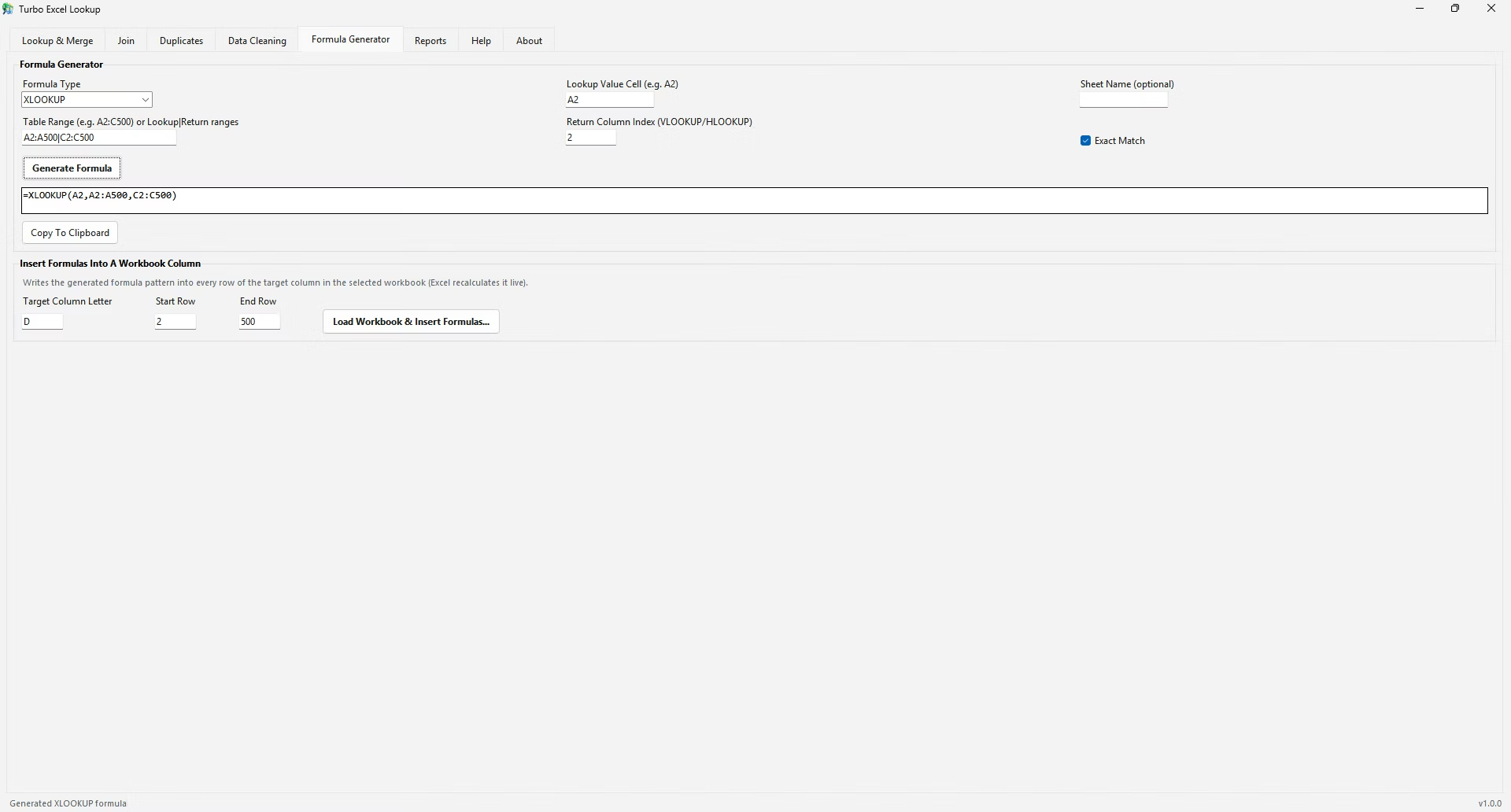
Sometimes a static, merged export is not what the job calls for. You need an actual formula sitting in the workbook that recalculates automatically as the source data changes. The Formula Generator tab exists for exactly that case, and it is often the fastest way to obtain correct lookup syntax without typing range references by hand. Choose a formula type, enter the lookup cell reference such as A2, the table or lookup and return ranges, and the return column index, and the application constructs the correct formula string immediately. It is also the quickest way to produce a correct v lookup formula when a colleague has specifically asked for one in the finished workbook.
| Formula Type | Generated Output |
|---|---|
| VLOOKUP | =VLOOKUP(A2,Range,2,FALSE) |
| XLOOKUP | =XLOOKUP(A2,LookupRange,ReturnRange) |
| INDEX/MATCH | =INDEX(ReturnRange,MATCH(A2,LookupRange,0)) |
| INDEX/XMATCH | =INDEX(ReturnRange,XMATCH(A2,LookupRange)) |
| HLOOKUP | =HLOOKUP(A2,Range,2,FALSE) |
| VLOOKUP wrapped in IFERROR | =IFERROR(VLOOKUP(A2,Range,2,FALSE),"") |
Every generated formula supports an optional sheet name reference, so that it correctly points at 'SheetName'!Range when your lookup table sits on a different tab, and an exact match toggle that switches between the FALSE/0 and TRUE/1 match-type arguments.
Writing Formulas Directly Into a Workbook
Beyond copying a single formula to the clipboard, the "Load Workbook & Insert Formulas" option opens an actual .xlsx or .xlsm file and writes the formula pattern into every row of a target column, across a start-row to end-row range that you specify, automatically shifting the lookup cell reference for each row before saving the result. Open the saved file in Excel and the formulas recalculate live, exactly as though you had typed them yourself. Note that the insert step accepts .xlsx and .xlsm workbooks only, so a legacy VLOOKUP XLS file has to be saved to .xlsx before formulas can be written into it.
The Interface: Eight Tabs, One Consistent Workflow
Turbo Excel Lookup is organized into eight tabs along the top of the window, each dedicated to a single job. Because every tab shares the same file-loading, column-selection, preview, and export controls, learning one tab means you already know how to operate the rest. The application is built on native Windows widgets, so it looks and behaves like a standard Windows program rather than a re-skinned web page.
Lookup & Merge
The core tab. Choose a base file and a lookup file, select the key columns to match on and the columns to pull back, set a match mode and return option, then run. This is the direct VLOOKUP and XLOOKUP replacement.
Join
Combine two whole tables the way a database would, with Left, Right, Inner, Full Outer, Anti, Semi, and Cross joins, for when you care about entire matched or unmatched row sets rather than a few returned columns.
Duplicates
Find and manage duplicate records based on the key columns you choose, with options to keep the first or last copy, show only the duplicate rows, or flag every row in place.
Data Cleaning
Standardize selected columns before matching: trim spaces, strip accents and non-printable characters, normalize emails, phone numbers, and currency, and convert between text and numbers.
Formula Generator
Build a genuine VLOOKUP, XLOOKUP, INDEX/MATCH, INDEX/XMATCH, HLOOKUP, or IFERROR-wrapped formula string, and optionally write it into a workbook column so Excel recalculates it live.
Reports
A running session log of every operation performed, which you can export to a text file or clear at any time, useful for keeping a record of what was done to a dataset.
Help
An in-application guide documenting every tab and feature in plain language, including a quick-reference table covering all eleven match modes.
About
Displays the application name, version, and copyright, a link to turbo-soft.com, your current license status, and a Check for Updates button that opens the product page in your browser.
Every data tab includes a live preview of the current table and one-click export to XLSX, CSV, or TSV, so you can confirm results before saving anything to disk.
Session Log and Reporting
The Reports tab maintains a plain-text session log of the actions you take during a working session. As you run lookups, joins, duplicate scans, and cleaning passes, each step is recorded, producing a straightforward audit trail of what happened to your data. Two buttons put you in control: Export Session Log saves the entire log to a .txt file you can keep alongside your output, and Clear Log resets it for a fresh session.
Supported File Formats
| Format | Read | Write | Notes |
|---|---|---|---|
| XLSX | Yes | Yes | The standard modern Excel workbook format, and the recommended choice for exports |
| XLSM | Yes | No | Macro-enabled workbooks are read normally; export the result as XLSX |
| XLSB | Yes, with pyxlsb | No | Requires the optional pyxlsb library; export results as XLSX, CSV, or TSV |
| CSV | Yes | Yes | Comma-separated text, the most portable option for handing data to other systems |
| TSV | Yes | Yes | Tab-separated text, useful when your data itself contains commas |
XLSB support requires the optional pyxlsb library to be installed alongside the application, whereas XLSX, XLSM, CSV, and TSV work out of the box. When you load a multi-sheet XLSX or XLSM workbook, a sheet dropdown appears automatically so you can choose exactly which sheet feeds into the operation, removing the need to split workbooks into single-sheet files beforehand.
If you are working with a legacy .xls workbook from an older version of Excel, open it in Excel and use Save As to convert it to .xlsx before loading it. The conversion takes a few seconds, preserves your data, and produces a file that every part of the application handles natively.
Performance and Architecture
Vectorized Fast-Path Matching
Exact, Case Insensitive, Ignore Spaces, Ignore Case & Spaces, and Ignore Accents modes run through the native merge operations in pandas rather than looping row by row, giving them a substantial speed advantage on large files.
Multi-Threaded Pattern Matching
Contains, Starts With, Ends With, Wildcard, Regex, and Fuzzy matching run on a thread pool configurable up to eight parallel workers, so pattern-based comparisons use multiple CPU cores instead of blocking on a single thread.
Background Processing, Responsive UI
Lookups, joins, duplicate scans, and cleaning operations run on background threads with a live progress bar, so the interface stays responsive rather than freezing on large datasets.
No Row Caps, No Demo Restrictions
Every export is unrestricted whether or not the application is activated. There is no reduced row limit and no watermark applied to unlicensed use; practical limits come down to the memory available on your machine.
In practice, this two-tier design means the matching mode you select is not only an accuracy decision but also a performance one. If your key columns are already reasonably clean, with consistent IDs, SKUs, or codes, staying with Exact Match or one of the normalized fast-path modes will always be quickest. Reach for Fuzzy, Regex, or the other pattern-based modes when you specifically need their flexibility, since the trade-off for row-by-row comparison is slower processing on very large lookup tables. Cleaning your data first is frequently the fastest overall route: a few seconds spent trimming and normalizing text can allow a fast-path mode where a slow one would otherwise be required, cutting total processing time substantially on large files.
System Requirements and Installation
| Requirement | Details |
|---|---|
| Operating system | Windows 10 or Windows 11, 64-bit |
| Microsoft Excel | Not required. The application reads and writes Excel files independently, though Excel is naturally useful for opening the results |
| Memory | Larger datasets benefit directly from additional RAM, since both source files and the result are held in memory during an operation |
| Processor | Any modern multi-core processor. Pattern-based match modes scale across up to eight worker threads |
| Internet connection | Required only briefly for license activation. All data processing happens locally |
| Optional component | The pyxlsb library, needed only if you intend to read XLSB workbooks |
Installation follows the standard TurboSoft pattern. Purchase through Gumroad, download the package, and run the application. On first launch you will be offered the activation dialog described in the licensing section below. There is no separate runtime to install and no dependency on a particular Excel version, because the file handling is built into the application rather than delegated to Excel through automation.
Privacy and Data Handling
Turbo Excel Lookup is a desktop application, and this has a direct consequence that matters more than any feature in the list above for anyone handling regulated data. Your spreadsheets are never uploaded anywhere. Files are read from your disk, processed in memory on your own machine using pandas, and written back to a location you choose. There is no cloud component in the data path, no account to create, and no server that holds a copy of your file while it is processed.
The only network activity the application performs is a brief license verification against Gumroad when you activate, plus opening your browser if you click the Check for Updates button. Neither transmits your data. If your work involves customer records, payroll information, patient identifiers, financial transactions, or anything else covered by data protection obligations, this distinction is significant, because uploading such files to a web-based converter or matching service is frequently prohibited by policy even when it is technically convenient.
Real-World Use Cases
Turbo Excel Lookup is built around a single generic capability, reliably matching rows across two data files, which makes it useful across a wide range of everyday spreadsheet problems. The tab you reach for changes with the task, whether that is a straight lookup, a full join, a deduplication pass, or a cleaning pass, but the underlying goal in each example below is the same one that drives most spreadsheet work: getting two datasets that were never designed to communicate with each other to line up correctly.
Sales and CRM Data Enrichment
Match a raw sales export against a customer master list to pull in account tier, region, or assigned sales representative, using Fuzzy or Ignore Case & Spaces matching to absorb the inevitable inconsistencies between how customer names were typed into two different systems. The unmatched export then becomes a worklist for whoever maintains the master list, which is usually a shorter and more productive conversation than reporting that the merge "did not work".
Marketing List Deduplication
Run the Data Cleaning tab's email normalization first, then use the Duplicates tab to flag or remove repeated subscriber records across merged mailing lists before a send, avoiding duplicate delivery and inflated list counts. Normalizing before deduplicating is essential rather than optional here, since a mixed-case address with a trailing space will not be recognized as a duplicate of the same address in clean form.
Finance and Payment Reconciliation
Match a bank statement export against internal transaction records using composite keys such as date plus amount, or a reference number where one exists, then export the unmatched rows to isolate the handful of transactions requiring manual review. Because the match statistics record how many rows matched and how many did not, the reconciliation itself is documented rather than merely performed.
Building Live Formulas for Handoff Files
When a merged result will be handed to somebody who continues adding rows over time, the Formula Generator can write a native XLOOKUP or VLOOKUP formula into the workbook rather than a static value, so the file keeps working correctly as new data is entered. This is the case where a formula genuinely beats a merge, and having both options in one application means you can choose on the merits rather than on what is available.
A Complete Example Workflow
Here is what a typical session looks like from beginning to end, using a common scenario: merging a product price list into a sales export.
- Step 1, clean first. Open the Data Cleaning tab, load the price list, select the SKU column, and apply Trim plus UPPERCASE so that every SKU is formatted consistently.
- Step 2, load your files. On the Lookup & Merge tab, load the sales export as Source A and the newly cleaned price list as Source B.
- Step 3, define the key. Add a key column pair matching the SKU column in the sales export to the SKU column in the price list.
- Step 4, audit the key. Run once with the Match Count return option to confirm that each SKU appears only once in the price list. If any count exceeds one, decide whether to deduplicate the price list or add a second key column.
- Step 5, choose a match mode. Select Case Insensitive to absorb any remaining formatting differences.
- Step 6, pick return columns. Tick "Unit Price" and "Category" from the price list to pull into the sales export.
- Step 7, set a fallback. Enter "Price Not Found" as the fill value so that any unmatched SKU is easy to spot rather than silently blank.
- Step 8, run and review. Click Run Lookup, check the match percentage in the statistics panel, and scan the preview table before exporting anything.
- Step 9, export. Export the full result as your merged sales file, and separately export the unmatched rows to send to whoever maintains the price list.
- Step 10, document. Export the session log from the Reports tab into the same folder, so the settings that produced the file are recorded alongside it.
Turbo Excel Lookup Compared With Native Excel Formulas
| Capability | Native VLOOKUP / XLOOKUP | Turbo Excel Lookup |
|---|---|---|
| Approximate or fuzzy text matching | Not built in; requires third-party add-ins or complex helper formulas | Built in, with an adjustable similarity threshold |
| Regex or wildcard matching | Not supported natively | Both supported directly as match modes |
| Composite multi-key matching | Requires concatenated helper columns | Add multiple key column pairs directly |
| SQL-style Anti, Semi, and Full Outer joins | Requires nested COUNTIF and IF formulas, or Power Query | Selectable join types in a single dropdown |
| Bulk data cleaning before matching | Manual formulas such as TRIM and SUBSTITUTE, column by column | One-click operations across selected columns |
| Match statistics: match rate, duplicate keys, timing | Not available without building your own summary formulas | Generated automatically after every run |
| Isolating rows that failed to match | Filter for #N/A manually, if the errors have not been hidden | A dedicated unmatched-rows export |
| Live, recalculating formula in the workbook | Yes, natively | Yes, through the Formula Generator's insert-into-workbook option |
| Audit trail of operations performed | None | Exportable session log |
| Performance on very large datasets | Can slow considerably with many live lookup formulas | Vectorized fast-path matching for exact and normalized modes |
The two approaches are not mutually exclusive. Many people use Turbo Excel Lookup for the heavy lifting, meaning fuzzy matching, joins, cleaning, deduplication, and bulk exports, and reach for the Formula Generator specifically when a live, self-updating formula is what the finished file actually requires.
Turbo Excel Lookup Compared With Power Query
Power Query, built into modern versions of Excel, is the closest thing Microsoft ships to what Turbo Excel Lookup does, and it is a capable tool that deserves a fair comparison rather than a dismissal. The two are genuinely different instruments suited to different situations.
| Consideration | Power Query | Turbo Excel Lookup |
|---|---|---|
| Best suited to | Repeatable pipelines refreshed on a schedule | Ad hoc and one-off matching between two files |
| Learning curve | Steeper; the query editor and its step model take time to learn | Shallow; every option is a visible control on a tab |
| Saved, reusable steps | Yes, queries are saved with the workbook and refresh | No, each session is configured fresh |
| Fuzzy text matching | Available in newer versions with limited controls | Built in, with a 50 to 100 percent threshold slider |
| Wildcard and regex matching | Not offered as native match modes | Both available as match modes |
| Match statistics after a run | Not produced automatically | Reported on every run and exportable |
| Runs independently of Excel | No, it lives inside Excel | Yes, a standalone Windows application |
| Join types | Comprehensive, including anti joins | Seven types selected from a dropdown |
The honest summary is this. If the same transformation runs every month against files that arrive in a consistent shape, and you are prepared to invest in learning the query editor, Power Query's saved and refreshable queries are the better long-term investment. If the task is a one-off reconciliation, or the files arrive in an unpredictable shape, or the matching problem is genuinely messy in ways that demand fuzzy or pattern-based comparison, Turbo Excel Lookup gets you to a verified answer faster and tells you more about the quality of that answer along the way. Many people reasonably use both.
Best Practices and Tips
Clean Before You Match
If two files disagree on spacing, casing, or accents, run the relevant columns through the Data Cleaning tab first, then match on the cleaned keys. This frequently converts a fuzzy problem into a clean exact match, which is both faster and more predictable.
Start With a Normalized Mode
Reach for Case Insensitive or Ignore Case & Spaces before jumping to fuzzy matching. The normalized modes run on the fast vectorized path and resolve the majority of real inconsistencies without any threshold guesswork.
Tune the Fuzzy Threshold Gradually
When fuzzy matching is genuinely needed, start the similarity threshold high, around 90 percent, and lower it only if real matches are being missed. Too low a threshold introduces false positives that you must then correct by hand.
Use Match Count to Audit Your Keys
Before committing to a merge, run the lookup with the Match Count return option. If a key you expected to be unique returns counts above one, your join key is less unique than you assumed, which is a signal to add a second key column.
Keep the Session Log
For any work that will be reviewed later, export the session log from the Reports tab. It is a lightweight way to document exactly which operations produced a given output file.
Pick the Right Join
Use an Anti join to find rows in one file with no match in the other, which is ideal for spotting missing records, and a Semi join when you want only the matched rows without duplicating columns from the second table.
Glossary of Terms
Data matching borrows vocabulary from spreadsheets, databases, and statistics, which makes the terminology harder to follow than the concepts themselves. This glossary defines the terms used throughout this page.
| Term | Definition |
|---|---|
| Base file (Source A) | The file you are adding information to. Its rows are preserved and its shape defines the result of a lookup. |
| Lookup table (Source B) | The reference file you are pulling information from. Its rows are searched rather than preserved. |
| Key column | The column whose values are compared to determine whether two rows describe the same thing. |
| Composite key | A key built from two or more columns combined, used when no single column is unique on its own. |
| Match mode | The rule that decides whether two key values count as equal, ranging from exact equality to approximate similarity. |
| Fuzzy matching | Matching based on a similarity score rather than equality, allowing near-identical text to match above a chosen threshold. |
| Similarity threshold | The minimum score, expressed as a percentage, at which a fuzzy pair is accepted as a match. |
| False positive | A pair that the match accepted but that does not, in fact, describe the same record. The most damaging kind of matching error. |
| Join | A database-style operation combining two tables into one according to how their keys relate. |
| Anti join | A join returning only the rows from one table that have no counterpart in the other. |
| Semi join | A join returning only the rows from one table that do have a counterpart in the other, without adding the second table's columns. |
| Deduplication | Removing or flagging repeated records so that each real-world entity appears once. |
| VLOOKUP | The vertical lookup function that searches down the first column of a range and returns a value from a column to its right. Learning how to use VLOOKUP in Excel means learning its four arguments and the ways each of them can silently go wrong. |
| V lookup formula | A common way of writing the same thing. A v lookup formula and a VLOOKUP formula are identical; only the spelling differs. |
| Table array | What Excel in VLOOKUP terms calls the range being searched. It must start at the column containing the search value, which is why the function cannot look to the left. |
| .xls (legacy format) | The Excel 97-2003 binary workbook format. A VLOOKUP XLS file still opens in Excel, but this application expects .xlsx, .xlsm, .xlsb, CSV, or TSV. |
Current Scope and What It Does Not Do
In the interest of setting accurate expectations, here is what Turbo Excel Lookup deliberately does not do in its current form. Knowing the boundaries in advance helps you judge whether it fits your workflow today.
- It does not save reusable lookup profiles, column mappings, or a list of recent projects. Each session is configured fresh.
- It does not run scheduled or unattended batch jobs, and there is no persistent job queue.
- It does not process entire folders or recurse through subfolders automatically. You load the specific files you want to work with.
- It does not provide a side-by-side before-and-after diff viewer with cell-level highlighting.
- It does not include undo, crash recovery, or automatic version history. Your originals are your safety net, so keep them.
- It does not open password-protected workbooks.
- It reads XLSB files with the optional pyxlsb library but does not write back to XLSB. Export those results as XLSX, CSV, or TSV instead.
- It does not read the legacy
.xlsformat directly, so a VLOOKUP XLS workbook needs a one-time Save As conversion to.xlsxin Excel first. - It does not preserve cell formatting, formulas, charts, or conditional formatting from the source workbook. It works with the data rather than the presentation.
If your workflow depends on any of these, it is worth confirming the current feature set on the product page before purchasing, since capabilities can change between releases.
Licensing
Turbo Excel Lookup is licensed through Gumroad. The first time you launch the application you will see an activation dialog where you can enter your purchase email and license key, or choose "Continue Without Activating". Either way, the application opens with full functionality and no feature restrictions. Once a valid license is verified it is cached locally on your machine, so you will not be asked again on future launches. You can activate, check your current license status, or open the TurboSoft product page to check for updates at any time from the About tab.
The license key field accepts only letters, digits, and hyphens, automatically converting to uppercase as you type, and the email field enforces a sensible maximum length. These are small details, but they mean the activation form rejects obviously malformed input immediately rather than sending it to Gumroad's servers and waiting for a rejection.
App Info
| App Name | Turbo Excel Lookup |
| Platform | Windows 10, Windows 11 (64-bit) |
| Category | Data Tools |
| Interface | Native Windows theme (tkinter/ttk, "vista" theme on Windows) |
| Tabs | 8 (Lookup & Merge, Join, Duplicates, Data Cleaning, Formula Generator, Reports, Help, About) |
| Match Modes | 11 (5 fast/vectorized, 6 pattern-based including fuzzy) |
| Join Types | 7 (Left, Right, Inner, Full Outer, Anti, Semi, Cross) |
| Formula Types | 6 (VLOOKUP, XLOOKUP, INDEX/MATCH, INDEX/XMATCH, HLOOKUP, IFERROR-wrapped) |
| Return Options | 4 (First Match, Last Match, All Matches, Match Count) |
| Read Formats | XLSX, XLSM, XLSB (pyxlsb), CSV, TSV |
| Export Formats | XLSX, CSV, TSV |
| Row Limits | None; exports are unrestricted with or without activation |
| Internet Required | Only briefly, for license activation. All data processing is local |
| License Management | Gumroad |
Frequently Asked Questions
Using VLOOKUP in Excel
How do you use a VLOOKUP in Excel, in one paragraph?
Click the cell where the answer should appear, type =VLOOKUP(, select the cell holding the value you are searching for, select the range containing both the search column and the column you want returned, press F4 to lock that range, type the column number counted from the left edge of that range, and finish with FALSE for an exact match. That really is all there is to how to use VLOOKUP in Excel; the difficulty is keeping the range and the column number correct as the workbook changes shape around them.
How do I use VLOOKUP when the two tables are in different files?
Open both workbooks and select the range in the second one while writing the formula, so Excel builds the external reference for you. It works, but the reference includes the full file path and breaks the moment either file is moved, renamed, or opened elsewhere. Loading both files as Source A and Source B here avoids the link entirely, because the matched values are written into a new exported file rather than pulled through a live reference.
Is the VLOOKUP Excel offers ever the better choice over this application?
Certainly. For a dozen values on a small, clean table, or when the finished workbook has to recalculate on its own after you hand it over, the native formula wins on sheer convenience. The combination of Excel and VLOOKUP becomes a liability mainly at scale, or when the keys need normalizing before they will match at all.
Can I run a VLOOKUP XLS workbook through this application?
Not without converting it first. A VLOOKUP XLS file in the legacy 97-2003 format still opens in Excel itself, but Turbo Excel Lookup reads .xlsx, .xlsm, .xlsb, CSV, and TSV. Open the file in Excel, use Save As to produce an .xlsx copy, and load that instead.
Replacing VLOOKUP and XLOOKUP
Is Turbo Excel Lookup a VLOOKUP replacement?
Yes. The Lookup & Merge tab performs the same job as VLOOKUP or XLOOKUP, matching rows from one file against another and pulling back the columns you choose, but through checkboxes and dropdowns rather than formula syntax. Because it runs on pandas rather than live worksheet recalculation, it comfortably handles far larger row counts than a formula in a cell.
How is it different from VLOOKUP or XLOOKUP?
VLOOKUP and XLOOKUP are formulas typed into cells, one lookup at a time. Turbo Excel Lookup matches across two whole files visually, with eleven match modes including case-insensitive, accent-insensitive, wildcard, regular expression, and fuzzy matching, none of which native lookup formulas offer, and returns every column you select in a single pass.
Do I still need to know how to write lookup formulas if I use this application?
Not for day-to-day matching, since the Lookup & Merge tab replaces the formula entirely. Formula knowledge remains useful if you need to leave a live formula in a workbook for somebody else to maintain, and in that case the Formula Generator tab writes a correct, working formula for you rather than requiring you to type it.
Why does my VLOOKUP keep returning #N/A?
The usual causes are leading or trailing spaces in the key, inconsistent capitalization, numbers stored as text in one file and as real numbers in the other, and an approximate match argument left as TRUE on unsorted data. The troubleshooting table earlier on this page lists how to confirm each cause, and none of them are faults in the v lookup formula itself. The normalized match modes and the Data Cleaning tab remove that entire category of error.
Does Turbo Excel Lookup also generate real Excel formulas?
Yes. The Formula Generator tab builds native VLOOKUP, XLOOKUP, INDEX/MATCH, INDEX/XMATCH, HLOOKUP, and IFERROR-wrapped VLOOKUP formula strings, and can write a formula into every row of a target column in an actual .xlsx workbook so that Excel recalculates it live when the file is opened.
Matching and Accuracy
Can it match data when the spelling or spacing does not match exactly?
Yes. Alongside Exact Match, there are Case Insensitive, Ignore Spaces, Ignore Case & Spaces, and Ignore Accents modes, plus Contains, Starts With, Ends With, Wildcard, Regular Expression, and Fuzzy similarity matching with an adjustable threshold slider.
How does fuzzy matching decide what counts as a match?
Fuzzy mode compares each pair of values and produces a similarity score from 0 to 100. You set a threshold with a slider from 50 to 100 percent, defaulting to 80, and only pairs scoring at or above that threshold are treated as matches, with the highest-scoring candidate returned.
What return options are available for a lookup?
Four: First Match, Last Match, All Matches concatenated into a single cell, and Match Count. The count option is especially useful for auditing whether a key you assumed was unique actually appears more than once in the lookup table.
Joins, Duplicates, and Cleaning
Can it join two tables like a database instead of doing a lookup?
Yes. The Join tab supports Left, Right, Inner, Full Outer, Anti, Semi, and Cross joins between two tables, so you can combine complete rows rather than pulling back individual lookup columns.
Can it find and remove duplicate rows?
Yes. The Duplicates tab checks one or more key columns and lets you keep the first occurrence, keep the last occurrence, show only the duplicate records, or mark every duplicate in place with Is_Duplicate and Duplicate_Group columns without deleting anything.
Does it clean messy data before matching?
Yes. The Data Cleaning tab trims spaces, removes extra spaces, strips line breaks and non-printable characters, removes accents, normalizes emails, phone numbers, and currency values, converts between text and numbers, and applies UPPERCASE, lowercase, or Title Case, all before you run a lookup or join.
Files, Formats, and Performance
What file formats does Turbo Excel Lookup support?
It reads XLSX, XLSM, XLSB (with the optional pyxlsb library), CSV, and TSV, including multi-sheet workbooks with a sheet picker, and exports to XLSX, CSV, and TSV.
Can it open legacy .xls files?
Not directly. Turbo Excel Lookup reads the modern XLSX and XLSM formats, XLSB with the optional pyxlsb library, plus CSV and TSV. If you have a legacy .xls workbook, open it in Excel and use Save As to convert it to .xlsx first. The conversion takes seconds and preserves your data. In short, a VLOOKUP XLS workflow is fine inside Excel itself, but this application expects the modern formats.
Is there a limit on the number of rows I can process?
There is no artificial row cap and no demo restriction, and every export is unrestricted regardless of license status. Practical limits depend on the memory available on your computer and, for pattern-based matching modes, on processing time.
Will it change my original files?
No. It reads your source files and writes results to a new file that you name on export, leaving the originals untouched. Since there is no built-in undo, those originals are your safety net, so keep them until the output has been verified.
Licensing, Privacy, and Support
How is Turbo Excel Lookup licensed?
Through Gumroad. On first launch you can activate with your purchase email and license key, or choose Continue Without Activating and open the application with full functionality. A valid license is cached locally so you are not asked again on future launches, and you can activate or check your status at any time from the About tab.
Is there a demo or row-limited mode?
No. There is no demo mode and no row-capped exports. With or without an activated license, the application opens with full functionality and all exports are unrestricted.
Does Turbo Excel Lookup require an internet connection?
No. Lookups, joins, deduplication, cleaning, and formula generation all run locally on your machine using pandas. An internet connection is used only briefly to verify a license key against Gumroad, and to open the product page if you click Check for Updates.
How does it compare with Power Query?
Power Query is a refreshable transformation pipeline built into Excel and suits repeatable, scheduled reporting well. Turbo Excel Lookup is a standalone desktop utility focused on ad hoc matching, adding fuzzy, wildcard, and regular expression match modes plus automatic match statistics without requiring you to learn the query editor. Many people use both.
Where do I get help if something is not working?
The Help tab inside the application documents every feature, including a quick-reference table of all eleven match modes. For anything it does not cover, the support page is the place to get in touch, and the activation guide covers licensing questions across all TurboSoft applications.