Rows where every numeric column reads zero are common in financial exports, inventory counts, and survey results - they often represent an account that had no activity, a product with no stock movement, or a respondent who skipped every numeric question. While technically valid data, these rows add no useful information and can distort averages, make charts harder to read, and pad out row counts in ways that make a sheet look busier than it actually is.
Unlike blank rows, an all-zero row is not empty in the traditional sense - Excel's Go To Special "Blanks" option will not catch it, since a zero is still a value. Finding and removing these rows requires checking the actual numeric content of each row.








A simple way to flag all-zero rows manually is to add a helper column with a formula like =SUM(B2:F2)=0, which returns TRUE only when every numeric cell in that row's range adds up to zero. Filtering the sheet by that helper column lets you see exactly which rows qualify before you delete anything, which is safer than deleting by eye across a large table.
It is worth deciding up front whether a row with some zeros and some blanks should count - the SUM-based check above treats blanks as zero for the purposes of the total, so a partially filled row can sometimes be caught unintentionally.
A common mistake is confusing a genuinely all-zero row with a row that simply has blank numeric cells, since a SUM-based helper formula treats blanks as zero by default and may flag a partially filled row incorrectly. It helps to combine the zero check with a COUNTA check on the same range, confirming that every relevant cell actually contains a value of zero rather than being empty, before deciding a row is safe to remove.
- Add a helper column next to your data with a formula such as =SUM(B2:F2)=0 covering your numeric columns.
- Fill the formula down for every row in your data range.
- Apply AutoFilter to the header row, then filter the helper column to show only TRUE.
- Select the visible filtered rows and delete them using Home > Delete > Delete Sheet Rows.
- Remove the AutoFilter and the helper column once the cleanup is complete.
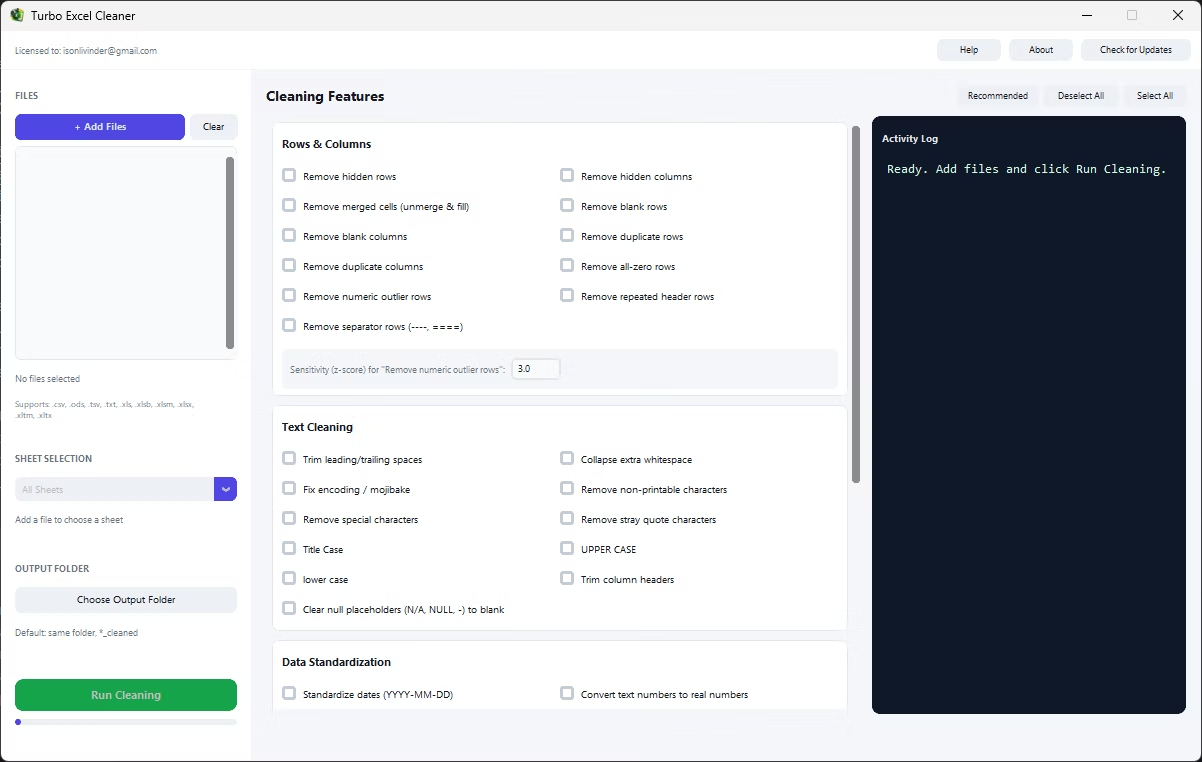
The helper-column approach works, but it has to be rebuilt every time you clean a new file, and it is easy to reference the wrong range by mistake. Turbo Excel Cleaner's Remove All Zero Rows feature checks the numeric cells across each row automatically and removes rows where every number is zero, without requiring you to build a formula or manually filter anything.
Like the rest of the app's Rows & Columns category, it applies the same rule consistently across every sheet in every file you load, so a batch of monthly financial exports can all be cleaned of dead, all-zero rows in a single run.
- Automatic detection of rows where every numeric value is zero
- No helper formulas or manual filtering required
- Applies consistently across every sheet in a batch
- Combine with blank row removal for a fully trimmed dataset
- Works on Excel, OpenDocument, and delimited text files
Does this remove rows with some zeros and some real values?
No, only rows where every numeric cell in the row is zero are removed; rows with a mix of zero and non-zero values are left in place.
What about rows with zeros and text labels together?
Text labels in a row are not treated as numeric values, so a row with a text label and all-zero numbers is still identified correctly as an all-zero row for the purpose of this feature.
Can I preview which rows will be removed first?
The app processes files directly into cleaned copies, so it is a good idea to review the output file after a first run and adjust your selected features if needed before processing a full batch.
Ready to clean your spreadsheets in bulk, offline, with full privacy?